


 Uncategorized
A garage door opener makes everyday access easy, but what happens when the opener stops working, the power goes out, or you need to operate the door manually? That is where the garage door emergency release comes in.
The emergency release, sometimes called the manual release or emergency release cord, disconnects the garage door from the automatic opener trolley so the door can be operated manually. However, using it incorrectly can be dangerous, especially if the garage door has a broken spring, damaged cable, or is badly out of balance.
The safest rule is simple: use the emergency release only when the door is in a safe condition and follow your opener manufacturer’s instructions. LiftMaster, for example, specifically warns that the release should be used with the door closed when possible because a weak or broken spring can allow an open door to fall unexpectedly.
Here’s what you need to know before pulling that red release handle.
What Is a Garage Door Emergency Release?
A garage door emergency release is a manual mechanism that disconnects the garage door from the automatic opener.
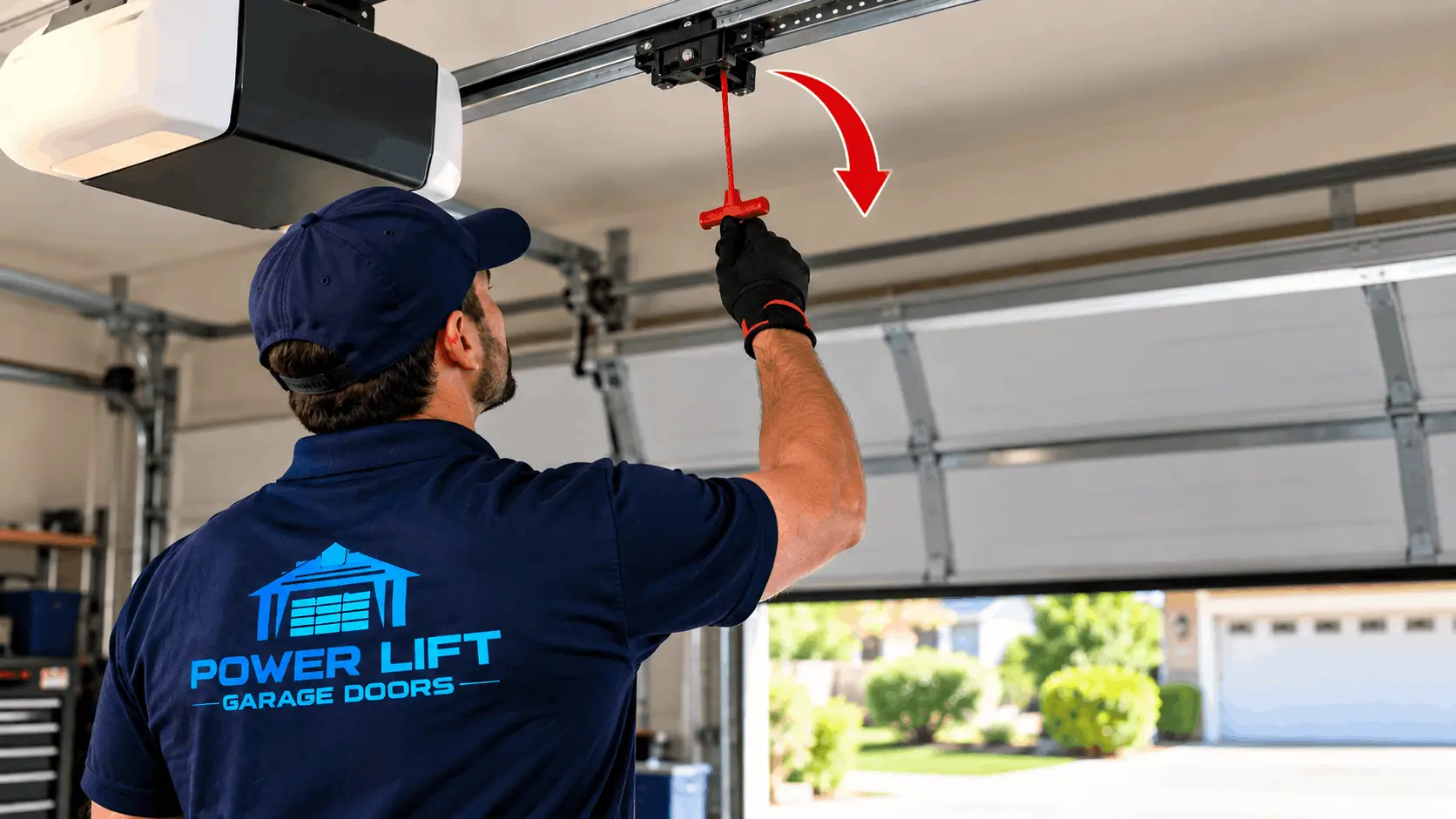
On many ceiling-mounted garage door openers, you will find a release cord hanging from the trolley. It commonly has a red handle, although the exact design can vary by opener manufacturer and model.
When the release is activated, the opener trolley separates from the door. This allows the door to be moved manually instead of relying on the opener motor.
The emergency release does not repair the garage door. It simply gives you a way to disconnect the automatic drive system.
CPSC safety materials describe this manual means of detaching the operator from the door as an important garage-door safety feature.
When Would You Need the Garage Door Emergency Release?
There are several situations in which you may need to disconnect the opener.
Power Outage
If your garage door opener does not have a functioning battery backup, a power outage can prevent normal automatic operation.
If the door itself is mechanically sound and your manufacturer’s instructions allow manual operation, the emergency release can disconnect the door from the opener.
Garage Door Opener Failure
A failed motor, circuit board, drive system, remote-control problem, or other opener issue can prevent automatic operation.
Disconnecting the trolley can help determine whether the problem is with the opener or the door itself, but only if the door is safe to operate manually.
You Need Manual Access
Sometimes you may need to move the door manually while troubleshooting an opener problem or after following the manufacturer’s instructions for manual operation.
The release mechanism is designed for this purpose.
Testing the Door’s Balance
A manual release can also be used during certain maintenance checks. CPSC guidance explains that, with the door closed, the opener can be disconnected and the door manually checked for proper balance. A properly balanced door should not unexpectedly fall or move rapidly when stopped.
However, checking balance does not mean adjusting the springs yourself.
How to Use a Garage Door Emergency Release Safely
The exact mechanism varies by opener, so your owner’s manual should always take priority. But many common systems follow a similar process.
1. Make Sure the Garage Door Is Closed
This is the most important safety step.
If possible, the garage door should be fully closed before you activate the emergency release. Why?
A garage door with a weak or broken spring may not be properly counterbalanced. Once disconnected from the opener, an open door could move unexpectedly or fall.
LiftMaster specifically warns users to disengage the trolley only when the door is closed, if possible.
If your door is already stuck open, severely damaged, crooked, or unstable, do not assume the emergency release makes it safe to operate manually.
That situation may require professional garage door repair.
2. Clear the Garage Doorway
Before touching the emergency release, make sure the entire doorway is clear.
Keep:
- People away from the door
- Children away from the area
- Pets away from the garage
- Vehicles away from the door’s path
- Objects away from the opening
LiftMaster’s instructions specifically warn against using the emergency release unless the garage doorway is clear of people and obstructions.
3. Locate the Emergency Release Handle
Look along the opener rail for the trolley assembly.
The garage door emergency release cord usually hangs down from this mechanism and often has a red handle.
Do not confuse this cord with the opener’s electrical wiring or other cables.
If you’re unsure which component is the manual release, check your opener’s owner’s manual before pulling anything.
4. Pull the Emergency Release as Directed
On many LiftMaster systems, the manufacturer instructs users to pull the emergency release handle downward to disconnect the trolley from the opener. Some systems use a slightly different motion, so follow the instructions for your specific opener.
Do not use the release cord to pull the garage door itself.
The release handle is designed to disengage the opener mechanism. It is not a substitute for the door’s lifting handle.
LiftMaster specifically warns against using the emergency release handle to pull the door open or closed.
5. Test the Door Carefully
Once the garage door opener has been disconnected, don’t immediately assume the door is safe to move.
Look at the door first.
Check for obvious signs of:
- A broken spring
- Loose or snapped cable
- Door sitting crooked
- Off-track rollers
- Bent tracks
- Damaged panels
- Unusual gaps or separation
- Severe imbalance
If everything appears normal and the manufacturer’s instructions allow manual operation, the door can generally be moved using the appropriate door handle.
Never use the emergency release handle itself to lift the door.
6. Move the Door Slowly
If the door is safe to operate manually, move it slowly and keep both hands away from pinch points.
Do not force the door if it feels unusually heavy, catches, binds, or suddenly drops.
A properly balanced garage door should move smoothly with controlled resistance. CPSC guidance warns that doors that are unbalanced, binding, or sticking should be serviced by a professional.
7. Reconnect the Opener When Appropriate
After the door has been safely returned to the closed position, the opener can generally be reconnected according to the manufacturer’s instructions.
For example, LiftMaster instructions explain that pulling the release handle in the specified direction can disengage the lockout feature, after which the trolley reconnects during the next opener operation.
Because mechanisms differ, do not assume every garage door opener reconnects in exactly the same way.
If the trolley does not reconnect properly, consult the owner’s manual or have the opener inspected.

When You Should NOT Use the Garage Door Emergency Release
The emergency release is useful, but it is not appropriate for every garage door problem.
The Door Has a Broken Spring
A broken garage door spring can make a garage door extremely heavy.
The springs counterbalance the weight of the door. When one fails, manually lifting the door can become dangerous.
PowerLift’s garage door repair information also identifies spring replacement as one of the repairs that should not be attempted as a DIY project because of the tension involved.
If you suspect a broken spring, leave the door alone and contact a professional.
The Door Is Off Track
An off-track garage door should not be manually forced back into position.
The problem may involve rollers, tracks, cables, hinges, or other components. Moving the door without addressing the underlying issue can cause additional damage.
PowerLift specifically recommends safely realigning an off-track door rather than continuing to operate it.
A Cable Is Broken or Frayed
A snapped garage door cable can leave the door uneven or unstable.
Don’t pull on the cable, attempt to reconnect it, or use the emergency release to force the door into operation.
This is a situation for professional garage door cable repair.
The Door Is Hanging Crooked
If one side of the garage door is noticeably higher than the other, stop.
A crooked door can indicate a cable, spring, roller, or track problem. Continuing to move it may worsen the damage.
The Door Is Extremely Heavy
If the door suddenly feels much heavier than usual, don’t try to compensate by using more force.
An unusually heavy door can be a sign of a failed or improperly adjusted spring system.
The Door Is Partially Open and Unstable
Using the release on an already-open door carries additional risk if the door is not properly balanced.
CPSC guidance specifically warns that weak or broken springs can increase the rate of door closure when the opener is disengaged.
If the door is stuck open and you cannot safely determine why, keep clear and call a garage door professional.
Emergency Release vs. Emergency Release Kit: What’s the Difference?
The terms can be confusing.
The emergency release mechanism is the built-in system that disconnects the garage door from the opener trolley.
An external emergency release kit, on the other hand, can provide a way to manually release the opener from outside the garage.
External release systems can be useful when there is no other pedestrian entrance into the garage and the opener cannot be accessed from inside.
For example, Chamberlain offers a quick-release key designed to provide exterior manual operation during power outages and opener failures.
The exact hardware and compatibility depend on the garage door and opener, so installation should follow the manufacturer’s instructions.
Can You Open a Garage Door Manually Without the Opener?
Yes, if the door is mechanically safe and the opener has been properly disconnected.
But manual operation is not a workaround for a damaged garage door.
If the opener is the only problem and the door itself is balanced and functioning correctly, manual operation may be possible.
If the door has a broken spring, damaged cable, off-track rollers, bent track, or another mechanical problem, manually forcing it open can make the situation worse.
The key distinction is:
Opener problem → manual operation may be possible.
Mechanical door problem → professional inspection may be necessary.
How to Tell Whether the Problem Is the Opener or the Door
Disconnecting the opener can sometimes help identify where the problem is.
If the door operates smoothly and remains balanced when safely operated manually, the opener may be the source of the problem.
If the door is extremely heavy, falls, binds, sticks, moves unevenly, or cannot be moved normally, the problem may be within the door’s mechanical system.
Possible causes include:
- Broken garage door spring
- Damaged cable
- Worn rollers
- Bent track
- Damaged hinge
- Door imbalance
- Panel damage
PowerLift’s garage door repair service covers these types of problems, including springs, cables, tracks, rollers, panels, and opener issues.
What Not to Do With a Garage Door Emergency Release
A few mistakes are particularly important to avoid.
Don’t pull the release while the door is open unless necessary and safe.
The door can become unstable if the spring system is weak or damaged.
Don’t use the release cord as a lifting rope.
The emergency release disconnects the trolley; it is not designed to lift the door.
Don’t force a heavy door.
Unexpected resistance usually means something is wrong.
Don’t adjust springs after disconnecting the opener.
Disconnecting the opener does not remove spring tension.
Don’t repair cables yourself.
Cables work as part of the counterbalance system and can create a serious hazard when damaged.
Don’t keep operating a damaged door.
Repeated operation can turn a manageable repair into a larger mechanical problem.
How to Stay Safe During a Garage Door Opener Failure
If your opener stops working, start by determining whether the problem is electrical or mechanical.
Check whether the opener has power and whether the wall control responds. If the opener is completely unresponsive, a power or opener issue may be involved.
If the opener makes noise but the door does not move, look for obvious mechanical problems without touching springs or cables.
If the door is crooked, stuck, extremely heavy, or visibly damaged, stop troubleshooting.
PowerLift’s garage door repair team handles opener failures as well as spring, cable, track, roller, panel, and other garage door problems.
How to Test the Emergency Release Safely
If your garage door and opener are functioning normally, you can review the manufacturer’s recommended emergency-release test procedure.
LiftMaster’s instructions for certain models specify testing the release with the door closed, confirming that the door can be opened manually, returning it to the closed position, and then reconnecting the trolley according to the model’s instructions.
The important part is to follow the instructions for your exact opener model.
Do not perform a test simply because an online article gives a generic procedure if your manufacturer provides different instructions.
If the door does not remain balanced, moves unexpectedly, or cannot be safely operated after disengagement, stop the test.
When to Call a Garage Door Professional
Call a professional if:
- The garage door has a broken spring
- A cable has snapped or is frayed
- The door has come off its track
- The door is crooked
- The door is extremely heavy
- The door falls or moves unexpectedly
- The opener repeatedly fails
- The trolley will not reconnect
- The door makes unusual grinding or popping sounds
- You cannot identify the cause of the problem
These symptoms can indicate mechanical issues that require more than simply disconnecting the opener.
PowerLift Garage Doors provides garage door repair and opener services in Pearland and the greater Houston area, including repair of springs, cables, tracks, rollers, panels, and opener systems.
How Regular Maintenance Can Prevent Emergency Problems
The best time to understand your garage door emergency release is before you actually need it.
Regular maintenance can identify worn components before they fail.
PowerLift’s tune-up process includes inspection of springs, cables, rollers, tracks, hardware, opener components, safety sensors, lubrication, and door balance.
During a routine inspection, a technician can also identify signs of wear that may eventually lead to an emergency repair.
For Gulf Coast homes, routine maintenance is especially useful because humidity can accelerate corrosion and wear on exposed metal components.
Need Help With a Garage Door That Won’t Open?
The garage door emergency release is useful when you need to disconnect a functioning door from its automatic opener, but it is not a solution for a broken spring, snapped cable, off-track door, or unstable garage door.
If your door is stuck, unusually heavy, crooked, damaged, or the opener is not working, avoid forcing it. A professional inspection can identify whether the problem is with the opener or the garage door’s mechanical components.
PowerLift Garage Doors provides garage door repair and opener services in Pearland, Houston, and surrounding areas, with same-day service available depending on scheduling and technician availability.
Frequently Asked Questions
What is a garage door emergency release?
A garage door emergency release is a mechanism that disconnects the garage door from the automatic opener so the door can be operated manually when appropriate.
Can I use the emergency release when the garage door is open?
If possible, manufacturers recommend using the emergency release when the door is closed. A weak or broken spring can make an open door unstable after the opener is disconnected.
Can I manually open my garage door after pulling the emergency release?
Yes, if the door is mechanically sound, balanced, and safe to operate manually. Do not manually force a door with a broken spring, damaged cable, off-track system, or severe imbalance.
What if the garage door emergency release won’t work?
Do not force the release mechanism. The problem may involve the trolley, release cable, door lock, or opener system. Check the manufacturer’s instructions or contact a garage door technician.
Is it safe to repair a garage door spring after using the emergency release?
No. Disconnecting the opener does not eliminate the tension stored in the springs. Spring adjustment and replacement should be handled by a qualified professional. CPSC guidance recommends professional service for spring, cable, and related hardware repairs.
