

 Uncategorized
If your garage door has ever groaned, sagged, or refused to budge, the spring is almost always the reason. It’s the single hardest-working part of the whole system, a coiled piece of steel doing the job of two or three grown adults, silently lifting a 130-to-400-pound door every time you leave for work or pull into the driveway.
Most homeowners never think about their garage door spring until it snaps. But not all springs are built the same way, and knowing which type is holding your door up changes everything: how it should be maintained, how long you can expect it to last, how much a replacement should cost, and most importantly, whether it’s a job you should ever attempt yourself.
This guide breaks down all seven types of garage door springs: how each one works, where it’s typically used, its realistic lifespan, and the warning signs that tell you it’s time to stop opening the door and start making a phone call.
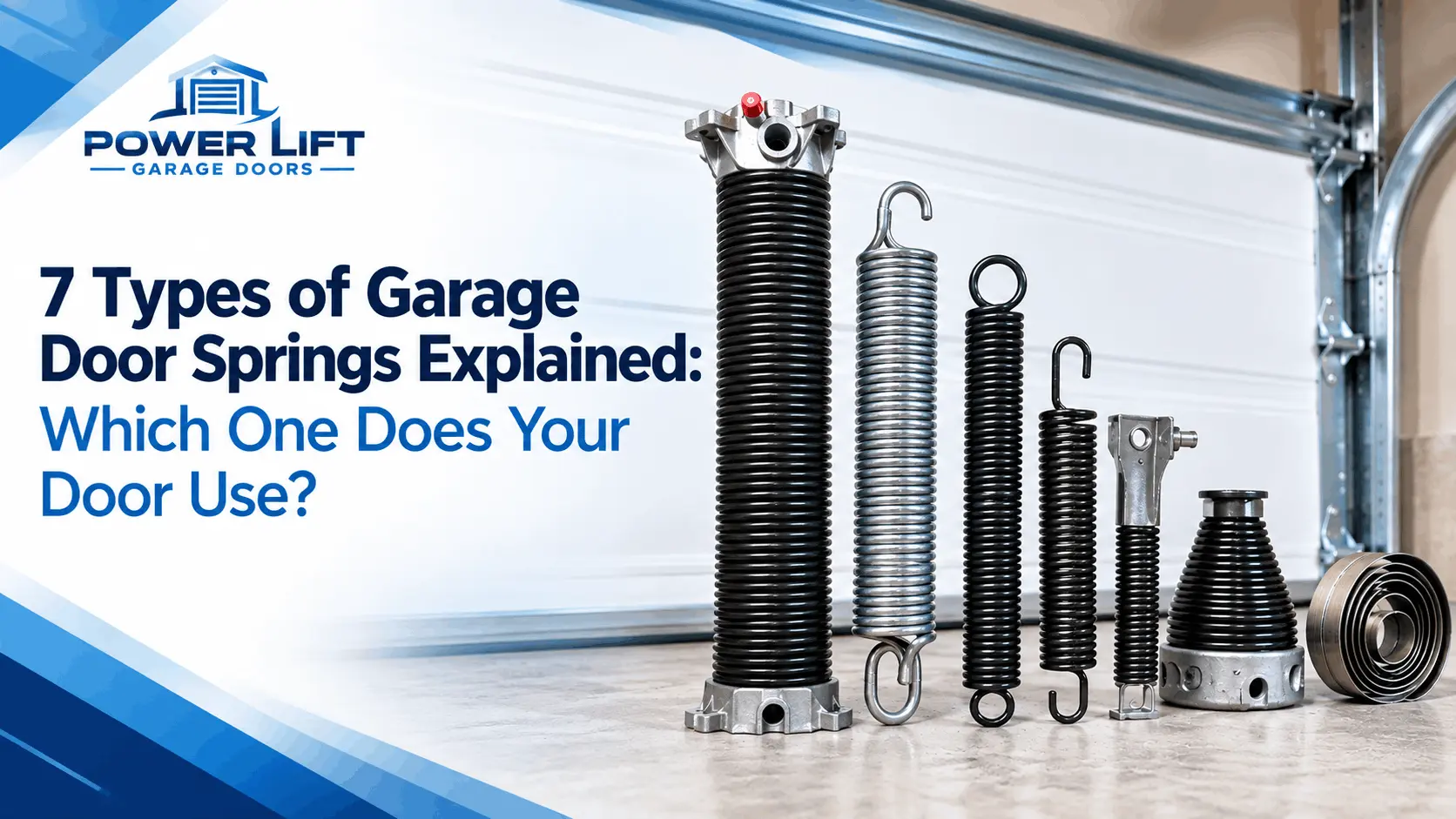
At a glance: Garage door springs fall into two families, torsion springs (mounted on a shaft above the door, four subtypes) and extension springs (mounted along the horizontal tracks, three subtypes) for seven distinct types in total.
How Garage Door Springs Work (Quick Primer)
A garage door doesn’t get lighter when a motor lifts it, the spring is what does that. Every garage door spring works on the same basic principle: it stores mechanical energy while the door is closed, then releases that energy to counterbalance the door’s weight as it opens. That’s why a properly balanced garage door feels almost weightless when you lift it by hand, even though it may weigh well over 150 pounds.
The two families of springs, torsion and extension, store and release that energy in fundamentally different ways, which is the first fork in the road when identifying your own door’s system.
Torsion Springs vs. Extension Springs: The Two Families
Definition: A torsion spring is mounted horizontally on a metal shaft directly above the closed door and lifts it by twisting. An extension spring is mounted above the horizontal tracks on either side of the door and lifts it by stretching.
Torsion springs sit on a metal rod (the torsion shaft) centered above the door opening, usually anchored to a bracket right above the header. As the door closes, cables wind the spring tighter around the shaft; that stored twisting force is what pulls the door open again. Torsion springs are the standard on most garage doors built or replaced in the last 20+ years because they’re safer, quieter, and put less strain on the opener.
Extension springs run along the upper tracks on both sides of the door and stretch (extend) as the door closes, then contract to help lift it. They’re common on older homes and lighter doors, largely because they’re cheaper to manufacture and don’t require the same overhead clearance as a torsion system.
Within those two families are the seven specific spring types covered below, four torsion, three extension.
The 7 Types of Garage Door Springs
1. Standard Torsion Springs
Short answer: The most common residential garage door spring, one or two coiled steel springs mounted on a shaft above the door, wound and unwound by winding cones at each end.
Standard torsion springs are what most garage door companies install by default on new sectional doors. The spring (or springs) sits on the torsion shaft with a stationary cone bolted to the center bracket and a winding cone at the end where a technician applies tension with winding bars.
- Where it’s used: The default choice for most single- and double-car residential garage doors.
- Pros: Long service life, smooth and relatively quiet operation, less wear on the garage door opener, doesn’t require safety cables the way extension springs do.
- Cons: More expensive to install than extension springs; requires several inches of headroom above the door; winding/unwinding under tension is genuinely dangerous without the right tools and training.
- Expected lifespan: Roughly 10,000 cycles at the industry-standard rating, about 7 to 14 years for a typical household (see the Expected Lifespan section below for how that math works).
2. Double (Dual) Torsion Springs
Short answer: Two standard torsion springs mounted side-by-side on the same shaft, typically used on heavier doors so that neither spring is overloaded.
A double torsion setup isn’t a different mechanism from a standard torsion spring — it’s two of them sharing the lifting load. This matters for heavier doors (double-wide, insulated, or carriage-style doors) where a single spring would be undersized, and it also builds in a small safety margin: if one spring weakens, the other can partially compensate until a technician replaces both.
- Where it’s used: Two-car garage doors, insulated or heavy wood/steel doors, and any door where a single spring is under-rated for the door’s weight.
- Pros: Better weight distribution, slightly more forgiving if one spring starts to weaken, standard on most heavier doors.
- Cons: Same installation risk as standard torsion springs, and both springs should be replaced together even if only one has failed, mismatched spring age is a common cause of door imbalance.
- Expected lifespan: Comparable to standard torsion springs per spring, though because the load is shared, dual springs often show less wear than a single spring carrying the full weight of a heavy door.
3. EasySet Torsion Springs
Short answer: A torsion spring mounted mid-shaft (in the center) rather than at the ends, designed to make winding and replacement more manageable without changing how the spring itself functions.
EasySet springs work on the same twisting principle as standard torsion springs, but their center-shaft position changes how a technician winds and services them. They’re less common than standard torsion springs but show up on specific manufacturer setups.
- Where it’s used: Residential doors from manufacturers that specify a mid-shaft torsion configuration.
- Pros: Functionally similar performance to standard torsion springs; positioning can simplify certain repair scenarios.
- Cons: Less universally available than standard torsion springs, so replacement parts may need to be sourced from a specific manufacturer.
- Expected lifespan: Similar cycle life to standard torsion springs when properly sized and maintained.
4. TorqueMaster (EZ-Set) Torsion Springs
Short answer: A torsion spring enclosed inside a metal tube instead of exposed on a shaft, a proprietary design (most associated with Wayne Dalton) built for safer servicing, but with a notably shorter lifespan.
TorqueMaster springs trade some longevity for safety: because the spring is fully enclosed inside a steel tube, there’s far less risk of injury from an exposed, tensioned coil during inspection or adjustment. That said, the enclosed design runs hotter and wears faster than an open torsion spring.
- Where it’s used: Primarily Wayne Dalton garage doors and any system specifically designed around an enclosed torsion tube.
- Pros: Enclosed design significantly reduces injury risk during servicing; compact footprint.
- Cons: Meaningfully shorter lifespan than standard torsion springs (roughly 3,000–5,000 cycles); replacement parts are proprietary and can be harder to source or more expensive.
- Expected lifespan: Around 3,000–5,000 cycles noticeably shorter than the 10,000-cycle standard, which in practice can mean replacement every 3–6 years for an average household.
5. Clipped-End Extension Springs
Short answer: An extension spring capped with a separate metal clip woven into each end — the most durable of the three extension-spring subtypes.
Because the end loop is a reinforced, separate piece rather than part of the coiled wire itself, clipped-end springs distribute stress more evenly and resist deformation better than the other extension designs.
- Where it’s used: Residential doors using an extension-spring system where a longer service life is a priority.
- Pros: Most durable extension spring type; loop is well-protected against distortion over time.
- Cons: Still carries the inherent downsides of any extension spring, see below and absolutely requires a safety cable.
- Expected lifespan: Generally holds up longer than open- or double-looped designs, though still shorter than a torsion spring under comparable use.
6. Double-Looped Extension Springs
Short answer: An extension spring with two layers of wire bent outward to form the end loop, moderately durable, but the loop can gradually pull and loosen with repeated use.
The double-loop design offers a middle ground: more reinforcement than a single open loop, but not as robust as a separately clipped end.
- Where it’s used: A common mid-tier choice on older residential doors with extension-spring systems.
- Pros: More durable than open-looped springs; widely available and inexpensive to replace.
- Cons: The loop itself is a common failure point over time as it works loose under repeated stretching.
- Expected lifespan: Moderate — typically shorter than clipped-end springs, longer than open-looped.
7. Open-Looped Extension Springs
Short answer: The most basic extension spring design, with a single layer of wire bent to form the end loop, the least durable of the seven types, but also the least expensive.
Because the loop is formed from a single, less-protected layer of wire, open-looped springs are the most prone to distortion and premature failure of any spring type on this list.
- Where it’s used: Older or budget-installed residential doors, often original equipment on entry-level garage doors.
- Pros: Lowest cost, simple design.
- Cons: Shortest realistic lifespan, highest failure risk, and like all extension springs, dangerous without a properly installed safety cable.
- Expected lifespan: The shortest of the seven types; often the first spring type a technician recommends upgrading during a repair visit.
Comparison Table: All 7 Spring Types Side by Side
| Spring Type | Family | Typical Cycle Life | Best For | Relative Cost |
|---|---|---|---|---|
| Standard Torsion | Torsion | ~10,000 cycles | Most residential doors | Moderate |
| Double (Dual) Torsion | Torsion | ~10,000 cycles per spring | Heavier/two-car doors | Moderate–High |
| EasySet | Torsion | Comparable to standard | Manufacturer-specific setups | Moderate |
| TorqueMaster (EZ-Set) | Torsion | ~3,000–5,000 cycles | Wayne Dalton doors, safer servicing | Moderate |
| Clipped-End Extension | Extension | Longest of the extension types | Budget doors wanting better durability | Low–Moderate |
| Double-Looped Extension | Extension | Moderate | Older residential doors | Low |
| Open-Looped Extension | Extension | Shortest overall | Entry-level/original equipment doors | Lowest |
Cycle counts reflect industry-standard manufacturer ratings under typical residential use; actual lifespan varies with usage frequency, climate, door weight, and maintenance.

ima
How to Identify Which Spring Your Garage Door Uses
You don’t need to be a technician to tell your spring type apart, look up, not at the tracks:
- Look directly above the closed door.
A metal shaft with one or two tightly coiled springs running across it means you have a torsion system. If that shaft has a solid metal tube covering the spring rather than an exposed coil, it’s likely a TorqueMaster/EZ-Set system. - Look above the horizontal tracks on both sides of the door.
A stretched spring running parallel to each track, connected to a pulley, means you have an extension spring system. Check the end of the spring: a separate metal clip means clipped-end, a double layer of bent wire means double-looped, and a single bent layer means open-looped. - Count the springs.
One spring centered above the door usually means a standard torsion system; two springs side-by-side on the same shaft typically means a double torsion system sized for a heavier door. - When in doubt, don’t touch it.
Torsion springs in particular can look identical from a few feet away despite very different tension levels. A quick photo sent to a garage door spring repair technician is the safest way to get a confirmed answer before you buy parts or attempt anything yourself.
Expected Lifespan: How Long Do Garage Door Springs Really Last?
Short answer: Most standard garage door springs are rated for about 10,000 cycles, roughly 7 to 14 years for a typical household that opens and closes the door two to four times a day. High-cycle springs can be rated for 20,000 to 30,000+ cycles.
A “cycle” is one full open-and-close of the door. Manufacturers rate springs by cycle count rather than years, because how long a spring lasts in calendar time depends entirely on how often the door is used:
- Light residential use (roughly 2 cycles/day): a 10,000-cycle spring can last close to 14 years.
- Average residential use (roughly 3–4 cycles/day): expect somewhere in the 7-to-10-year range.
- Heavy use (a garage used as a main entrance, or a home business, 6+ cycles/day): the same spring may need replacing in 5 years or less.
- High-cycle springs (rated 20,000–30,000 cycles, occasionally up to 100,000 for commercial-grade applications) roughly double or triple that lifespan and are worth considering for high-traffic households.
TorqueMaster/EZ-Set springs are the notable exception, their enclosed design shortens realistic cycle life to roughly 3,000–5,000 cycles, meaning more frequent replacement regardless of household size.
Maintenance Recommendations
Springs aren’t a “set it and forget it” component, but the maintenance homeowners can safely do themselves is limited and specific:
- Lubricate annually.
A light coat of garage-door-specific spring lubricant (not household oil or WD-40, which attract grit) reduces friction and extends life. Apply it to the coils, not the winding cones. - Watch and listen, don’t touch.
Visually check for gaps between coils, rust, or fraying, but leave adjustments, winding, and tension changes to a professional. - Keep the track and rollers clean.
A door that binds on dirty or misaligned tracks forces the spring to work harder than it should, accelerating wear. - Schedule a professional balance check yearly.
A technician can test door balance and spring tension safely in a few minutes as part of routine garage door maintenance, catching a weakening spring long before it snaps. - Don’t ignore noise changes.
A new grinding, popping, or squeaking sound during operation is often the earliest warning sign a spring is wearing unevenly.
Safety Considerations
This is the section to take most seriously. Garage door springs operate under extreme mechanical tension, a fully wound torsion spring stores enough energy to cause serious injury or worse if it releases uncontrolled, and a snapped extension spring without a safety cable can become a genuine projectile.
- Extension spring systems must have a safety cable running through the spring and secured at both ends. If yours doesn’t have one, that’s a same-day call to a professional, not a weekend project.
- Never place your fingers near the springs, cables, pulleys, or bottom brackets while the door is in motion or under tension.
- If a door has two springs and one breaks, industry guidance is to replace both, even if the second spring still looks fine. Mismatched spring age is a common cause of doors that suddenly go out of balance.
- Winding or unwinding a torsion spring requires the correct winding bars and technique. Improvised tools (screwdrivers, for instance) are a leading cause of serious DIY injuries with garage door springs.
- If you smell burning, see visible spring damage, or the door suddenly feels far heavier than usual, stop using it and treat it as an emergency rather than something to “keep an eye on.”
Signs a Garage Door Spring Needs Replacement
- The door feels noticeably heavier than usual when lifted manually
- Visible gap or separation in the spring’s coils
- A loud bang or “gunshot” sound (often the moment a torsion spring snaps)
- The door opens unevenly or looks crooked when partially open
- The garage door opener strains, stalls, or reverses without finishing the cycle
- Slack or looseness in the cables at the bottom corners of the door
- Visible rust, fraying, or stretching on an extension spring
If you notice more than one of these signs, it’s time for emergency garage door repair rather than waiting for the spring to fail completely, a spring that’s already showing stress rarely fixes itself, and a full failure can also damage the opener, cables, or door panels.
Professional Repair vs. DIY: Where to Draw the Line
There’s a clear, sensible line here, and it isn’t really about skill level, it’s about the physics involved.
Reasonable for most homeowners:
- Visual inspections and listening for changes in sound
- Applying spring lubricant
- Keeping tracks and rollers clean
- Noticing and reporting early warning signs
Should always go to a professional:
- Winding, unwinding, or adjusting spring tension
- Replacing any spring type
- Installing or repairing a missing safety cable
- Diagnosing why a door feels unbalanced or heavy
- Any repair involving the torsion shaft, cable drums, or bottom brackets
Garage door springs are inexpensive compared to the injuries or the additional damage to your door, opener, and vehicle, that can result from a DIY attempt gone wrong. A trained technician has the right winding bars, tension gauges, and experience to size and install the correct spring type safely, and most reputable providers back the work with a warranty that a DIY repair simply can’t match.
FAQ
What are the 7 types of garage door springs?
Standard torsion, double (dual) torsion, EasySet torsion, TorqueMaster (EZ-Set) torsion, clipped-end extension, double-looped extension, and open-looped extension.
How do I know what type of spring my garage door has?
Look above the door: an exposed coiled spring on a shaft is torsion, while a covered tube over that shaft usually means TorqueMaster. Springs stretched along the tracks on either side of the door are extension springs — check the end loops to tell the three extension subtypes apart.
Which garage door spring is safest?
Torsion springs are generally considered safer than extension springs because they’re under controlled tension on a fixed shaft rather than stretched in the open, and they don’t rely on a separate safety cable to contain a failure the way extension springs do.
How long do garage door springs last?
Most standard torsion springs are rated for about 10,000 cycles, translating to roughly 7 to 14 years of typical residential use. High-cycle springs can last 20,000 to 30,000+ cycles; TorqueMaster springs typically last only 3,000 to 5,000 cycles.
Can I replace a garage door spring myself?
It’s strongly discouraged. Springs are under enough tension to cause serious injury, and the job requires specific tools (winding bars) and training. This is one of the few garage door repairs where professional service is the recommended approach almost universally.
Why do some garage doors have two springs instead of one?
Heavier doors, double-car, insulated, or solid wood/steel doors, need more lifting force than a single spring can safely provide, so manufacturers spec two torsion springs sharing the shaft.
What is a TorqueMaster spring?
A torsion spring enclosed inside a steel tube rather than exposed on the shaft, most commonly found on Wayne Dalton garage doors. It’s designed to be safer to be around during inspection but has a shorter typical lifespan than standard torsion springs.
How much does garage door spring replacement cost?
Cost depends on spring type, door weight, and whether one or two springs need replacing; a technician can give an accurate quote after confirming your spring type and door specs during an inspection.
Key Takeaways
- There are 7 main garage door spring types across two families: torsion (standard, double, EasySet, TorqueMaster) and extension (clipped-end, double-looped, open-looped).
- Torsion springs are generally more durable, quieter, and safer than extension springs, which is why they’re the standard on most modern residential doors.
- Standard springs are typically rated for about 10,000 cycles (roughly 7–14 years of average use); TorqueMaster springs wear faster, at 3,000–5,000 cycles.
- Extension spring systems must have a safety cable, this isn’t optional, it’s a safety essential.
- Identifying your spring type is safe to do visually from a few feet away; winding, adjusting, or replacing any spring type is not a DIY task.
- Multiple warning signs — a heavier-feeling door, visible coil gaps, a loud bang, uneven opening, mean it’s time to call a professional, not wait it out.
Conclusion
Garage door springs don’t get much attention until the day they fail and by then, the safest and most cost-effective move is always the same one: call a professional rather than reach for a wrench. Understanding which of the seven spring types is holding your door up won’t make winding one safe to do yourself, but it will help you ask the right questions, recognize warning signs earlier, and know what to expect when it’s time for a replacement.
If your garage door feels heavier than it used to, sounds different when it opens, or you’re simply not sure which spring type you have, a quick professional inspection settles it in minutes. If you’re in the Pearland, TX area, PowerLift Garage Doors can identify your spring type, check your door’s balance, and handle everything from routine maintenance to same-day emergency repairs, safely, and without the guesswork.
